Wine Bar Near Empire State Building: Plan Your AYZA Visit
AYZA Wine & Chocolate Bar is a four minute walk from the Empire State Building. Here is the route, what...
Ayza Wine Bar NYC | Wine & Chocolate Bar in Midtown Manhattan


Remote event planning NYC organisers do from another city has one defining constraint: you cannot walk the room. Everything that a fifteen minute site visit would have told you has to be extracted from photographs, floor plans and email, and every assumption you leave unchecked becomes a surprise on the day.
Alumni committees, association chapters and distributed teams run into this constantly: the guests are in New York, the organiser is not. This is the method that works, written as the sequence you actually follow.
Quick answer: Plan remotely by documenting everything in one shared brief, getting photographs of the exact layout you have booked, appointing a local deputy who can arrive early, agreeing a written change control process, and confirming final numbers a week ahead. Restaurant private events in Midtown start around $69 per person and typically need three to four weeks of lead time.

| What goes wrong | Why it happens remotely | Prevention |
|---|---|---|
| Layout is not what you pictured | Website photos show the room empty and from one angle | Ask for photos of your exact agreed setup |
| Guests cannot find the door | You have never approached the building yourself | Send a street level photo with the invitation |
| Dietary requests get lost | Sent as a count in a long email thread | One list, by name, in a shared document |
| Invoice is higher than the quote | Bar and overtime were never capped | Itemise every line before signing |
| Nobody can make decisions on the night | The organiser is three time zones away | A named local deputy with authority |
| Outdoor space is unusable | Weather fallback was assumed, not agreed | Fallback and decision deadline in writing |
Every one of these is preventable, and every one of them is prevented by writing something down rather than by spending more money.
The single biggest failure in remote planning is decisions scattered across email threads, messages and calls. Create one shared document at the start and make it the only source of truth. If it is not in the brief, it is not agreed.
Share it with the venue rather than keeping it internal. A venue that can see your whole plan catches the thing you missed.
You cannot walk the room, so ask for the things a walk would have given you. Most venues will do a video call from the space if you ask, and that ten minutes is worth more than twenty photographs.
Ask specifically for: photographs of the room set up in your agreed layout rather than the marketing shots, a picture of the entrance from the street, the dimensions of the tables you will be using, confirmation of where power outlets are if you have AV or a DJ, and step free access details for the entrance and the bathrooms. If part of your event is outdoors, ask what the heated area covers and where guests go if the weather turns.
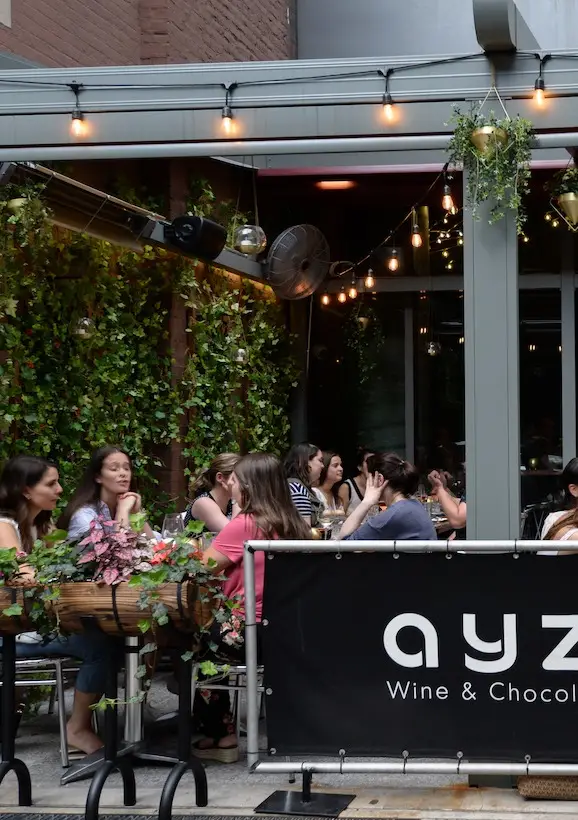
For a Midtown example, AYZA at 11 West 31st Street has an indoor dining room and a heated garden behind it, seats up to 20 and holds up to 40 standing, and offers private tours by appointment. If you have anyone local, send them on that tour in your place.
A short film of the room, set up for a group, is a useful reference point when you are describing the space to your committee.
Somebody who will be in the room needs the authority to make small decisions without calling you. Name them in the brief, give the venue their number, and tell them explicitly what they can decide alone.
A workable split: the deputy decides anything under an agreed dollar amount and anything that has to be resolved in under ten minutes, such as moving a table, adjusting music volume, or extending the bar by half an hour within the cap. Anything above that threshold, or anything that changes the contract, comes to you. Write the threshold down. A deputy without a number will either call you about everything or nothing.
Ask them to arrive thirty minutes early, photograph the room as set, and send it to you before guests arrive. That single photograph is your last chance to correct anything.
Choose from the venue’s published menu where you can, because it is the thing you can both point at. At AYZA the reference is the dinner menu: boards for two at $35 and $39, White Truffle Pizza at $16, Braised Short Rib at $33, Pici Cacio e Pepe at $24, and Cauliflower with Wild Mushrooms at $25, with vegetarian, vegan and gluten free dishes marked.
Collect dietary requirements and drink preference in the same RSVP field, then send the kitchen a list by name a week ahead. Counts are useless to a kitchen trying to plate an event. Confirm in writing that the non alcoholic options are included in the package rather than charged separately, so nobody is handed a bill for a mocktail at an event you are paying for.
Numbers move. What matters is knowing the deadlines before they arrive. Get four dates in writing: when the final guest count is due, when the menu locks, when the deposit is due and when the balance is, and the last date you can cancel or reduce numbers without penalty.
Then log every change in one place with a date and who agreed it. Remote planning generates a lot of small verbal agreements on calls, and those are exactly the ones that go missing. A two line entry in the change log after each call takes thirty seconds and settles every later dispute. Package details and capacities for a Midtown example are on the private events page.
| Time | What happens | Who owns it |
|---|---|---|
| Start minus 30 | Deputy arrives, checks layout, photographs the room | Local deputy |
| Start minus 15 | Vendors in, décor placed, music tested | Deputy and venue |
| Start | Doors, first drinks, greeting at the entrance | Venue and deputy |
| Start plus 30 | Structured activity or tasting begins | Venue guide |
| Start plus 90 | Any speech, kept short | Named speaker |
| Finish minus 30 | Bar cap reached, last orders announced | Venue |
| Finish | Close, vendor clear up, deputy settles anything outstanding | Deputy |
Send the run sheet to the venue and the deputy two days before, on one page. If it does not fit on one page, it will not be read.
Be reachable and then be quiet. Confirm you have the deputy’s photograph of the set room, check the guest count has not changed, and then let the people in the room run it. Remote organisers who message every fifteen minutes make the evening worse, because the deputy ends up managing you instead of the event.
The next morning, ask three questions of a handful of guests: what worked, what would you change, and would you come to the next one. Three questions the morning after get answered. A ten question survey a week later does not.
Keep one shared brief as the only source of truth, replace the site visit with a video call and photographs of your agreed layout, appoint a local deputy with decision authority, and log every change with a date.
Photographs of the room in your agreed setup rather than marketing shots, a street level photo of the entrance, table dimensions, power outlet locations, step free access details and the weather fallback for any outdoor space.
A named local deputy who arrives thirty minutes early, photographs the set room and has written authority to decide anything under an agreed dollar amount without calling you.
Three to four weeks is the minimum for a restaurant private event and six weeks is safer when you cannot visit, since you need time for photographs and revisions.
Itemise every line before signing, cap the bar or set it to a limited selection, agree an overtime rate in advance, and confirm what happens if guest numbers fall below the minimum.
As a list by name in the shared brief, sent a week ahead. A count tells the kitchen nothing about who needs what when the plates go out.
Remote event planning NYC guests will enjoy comes down to documentation and one person in the room. Write the brief, send the date and headcount range, and ask for photographs of the exact layout with your quote.
Choosing a date from another city is easier with the official visitor site, NYC Tourism, which shows the weeks when hotels and traffic are at their worst.
Capacities, prices and policies were checked against ayzanyc.com on September 9, 2026. Confirm current terms with the events team before signing.