Wine Bar Near Empire State Building: Plan Your AYZA Visit
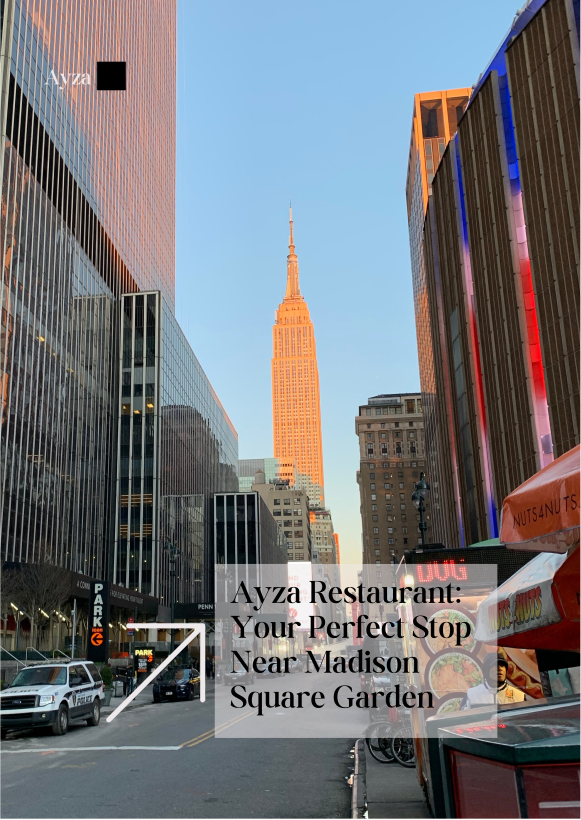
AYZA Wine & Chocolate Bar is a four minute walk from the Empire State Building. Here is the route, what...
Ayza Wine Bar NYC | Wine & Chocolate Bar in Midtown Manhattan


New American cuisine is one of those labels that tells you both a lot and nothing. It is on thousands of restaurant listings, it covers wildly different kitchens, and almost nobody can define it when asked. It does mean something specific, though, and knowing what New American food actually is makes it much easier to work out whether a place is for you before you book.
Quick answer: New American cuisine describes a kitchen that draws technique and ingredients from several traditions, cooks seasonally with local produce, and is not bound by one national cuisine. It is not the same as fusion, which combines two named cuisines deliberately. AYZA in Midtown sits adjacent to it: a European leaning menu built around sharing, with New York wines and chocolate made in house.
The label emerged in the United States in the late twentieth century, as a shorthand for restaurants that had stopped organising themselves around a single European tradition. Before it, a serious restaurant was usually French, or Italian, or a steakhouse. The kitchens that broke that pattern needed a name, and by the early 1980s New American cuisine was the one that stuck.
Two things drove it. Better access to ingredients from everywhere, and a generation of chefs trained in classical technique who wanted to cook with what was growing locally rather than with what a French menu required. The result was a category defined less by a set of dishes than by a set of permissions.
The groundwork was laid in California. Alice Waters opened Chez Panisse in Berkeley in 1971 with a menu built around what local farms could supply that week, which sounds unremarkable now and was close to heretical then. Jeremiah Tower, who ran her kitchen through the mid seventies, pushed it further by writing menus around American regional produce rather than French templates. What they were doing became known as California cuisine, and it is the direct ancestor of what the rest of the country later called New American.
The French influence arrived through nouvelle cuisine, the movement that had already loosened classical French cooking in the sixties and seventies: lighter sauces, shorter cooking times, the ingredient rather than the technique as the point of the dish. American chefs took that permission and applied it to produce no French kitchen would have recognised.
By the early eighties the idea had spread east. Wolfgang Puck opened Spago in Los Angeles in 1982 and made the approach commercially legible, putting smoked salmon and duck sausage on pizzas. In New York, Larry Forgione opened An American Place in 1983 and built relationships with small domestic farms and cheesemakers at a time when nearly everything prestigious on a menu was imported. The farm to table movement that followed in the nineties is the same impulse, formalised.
You will also see this cooking described as contemporary American or modern American. In practice the three are interchangeable. New American cuisine is simply the phrase that Yelp, OpenTable and most restaurant listings settled on, which is why it appears on so many menus and explains so little.
The freedom is the point and also the risk. A kitchen with no tradition to answer to can produce something coherent and personal, or it can produce a menu that is simply a list of popular things with no relationship to each other.
| New American | Fusion | |
|---|---|---|
| Starting point | Local season and the chef’s own training | Two named cuisines, combined deliberately |
| On the menu | Dishes that stand on their own terms | Dishes that announce the combination |
| Typical description | Roasted chicken, avocado salsa verde | Korean barbecue tacos |
| Risk when it fails | Incoherence, a menu with no point of view | Novelty without balance |
The distinction matters when you are reading a menu. Fusion tells you what two things are being combined. New American tells you only that the kitchen has decided for itself, which means you have to judge the menu rather than the label.
Five signals, all readable from the menu before you book.
The third one carries the most weight. A menu with an idea running through it is worth eating from. A menu that is a list of things people like is a menu you will not remember.
Portions are usually moderate rather than enormous, and menus lean toward sharing. Sourcing is often named. Cooking tends to be direct: roasting, braising, grilling, with sauces used to season rather than to cover.
Prices land in the middle of the market. In Manhattan, main courses in this category typically run from the mid twenties to the mid thirties, with shared starters and boards below that. That is roughly where the dinner menu at AYZA sits too: boards for two at $35 and $39, warm plates from $11, and mains from $24 to $33.
AYZA describes its kitchen as European inspired rather than New American, and that is the honest label. But it shares most of the working habits: a short menu, named ingredients, plates built for sharing, and no obligation to reproduce a national cuisine.
The repeated idea, in the terms above, is chocolate. It is made in house, it appears as pairing flights alongside wine, as fondue for two and as the Chocolate Martinis that have been on the list since 2007. The second idea is New York: five wines from the Finger Lakes and the Hudson Valley are poured by the glass on the cocktails and wines menu, alongside French, Italian and Californian bottles.
| Dish | Price | Notes |
|---|---|---|
| Fromage Board / Maison Board | $35 / $39 | For two, and 15 percent off any bottle of wine |
| Empire Steak Tartare | $21 | Hand cut New York steak, quail egg |
| White Truffle Pizza | $16 | Garlic cream, beef pastrami, truffle oil |
| Pici Cacio e Pepe | $24 | Hand rolled, vegetarian |
| Cauliflower & Wild Mushrooms | $25 | Vegan and gluten free, a main rather than a side |
| Roasted Chicken | $27 | Gluten free, avocado salsa verde |
| Braised Short Rib | $33 | Gluten free, port wine jus |
By the five tests above, that menu passes on length, specificity, a repeated idea and a genuine vegetarian and vegan main. AYZA is at 11 West 31st Street, three blocks from Herald Square, and opens at 4 pm daily.
A kitchen that draws technique and ingredients from several traditions, cooks seasonally with local produce, and is not bound by any single national cuisine. It is defined by freedom rather than by a fixed set of dishes.
No. Fusion combines two named cuisines deliberately and says so on the menu. New American starts from the local season and the training of the chef, and the dishes stand on their own terms.
Look for a short menu, specific named ingredients, one idea the kitchen keeps returning to, a real vegetarian main course, and a menu that changes through the year.
In Manhattan, typically from the mid twenties to the mid thirties, with shared starters and boards below that. AYZA mains run $24 to $33 and boards for two are $35 and $39.
AYZA describes its kitchen as European inspired rather than New American, but shares the working habits: a short menu, named ingredients, sharing plates and no obligation to one cuisine.
Usually yes, and it is one of the better tests. At AYZA the Pici Cacio e Pepe at $24 is vegetarian and the Cauliflower with Wild Mushrooms at $25 is vegan and gluten free.
The same thing as New American cuisine. The word food usually points at the dishes rather than the category: seasonal, mostly local ingredients, technique borrowed from several traditions, and familiar formats such as a burger, a roast chicken or a grain bowl treated seriously and reworked.
In practice yes. Modern American and contemporary American describe the same cooking. New American is simply the label that restaurant listings and review sites standardised on, so it is the one you see most often on menus.
Run the five tests on any New American restaurant menu you are considering, then run them here. A short list, named ingredients and one idea the kitchen keeps returning to is most of what you need to know.
Menu items and prices were checked against ayzanyc.com on September 9, 2026. Price ranges for the category are general observation rather than a survey.