Wine Bar Near Empire State Building: Plan Your AYZA Visit
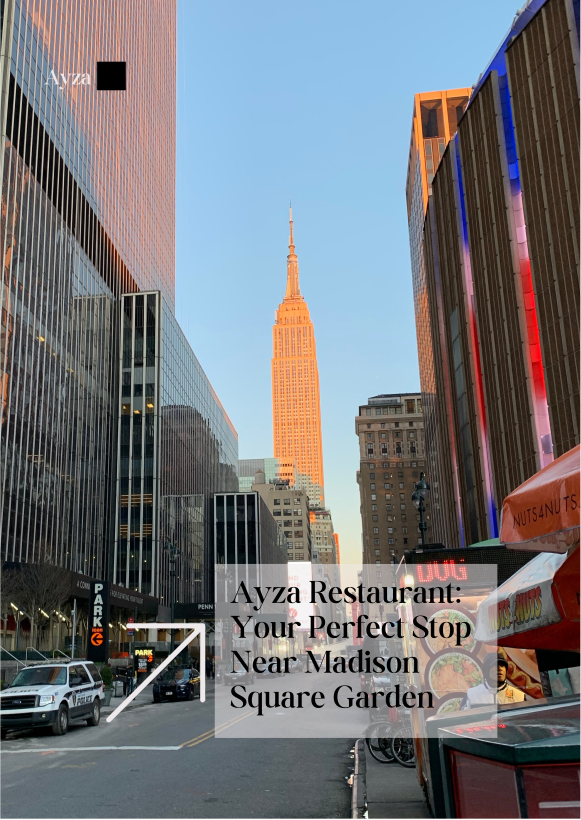
AYZA Wine & Chocolate Bar is a four minute walk from the Empire State Building. Here is the route, what...
Ayza Wine Bar NYC | Wine & Chocolate Bar in Midtown Manhattan


Most corporate event food ideas lists are catalogues of food. That is the wrong starting point. The question is not what to serve, it is what the food has to do: keep people standing and circulating, get them seated and listening, or give a room of strangers something to talk about. Pick the job first and the menu writes itself.
Quick answer: Match the food to the agenda. Standing receptions need one bite items eaten with one hand. Seated dinners need a short menu with two choices per course. Tastings need small portions with a structure. Handle dietary requirements at the RSVP stage by name, budget roughly 30 percent above the per person headline for tax and service, and confirm final numbers a week ahead.
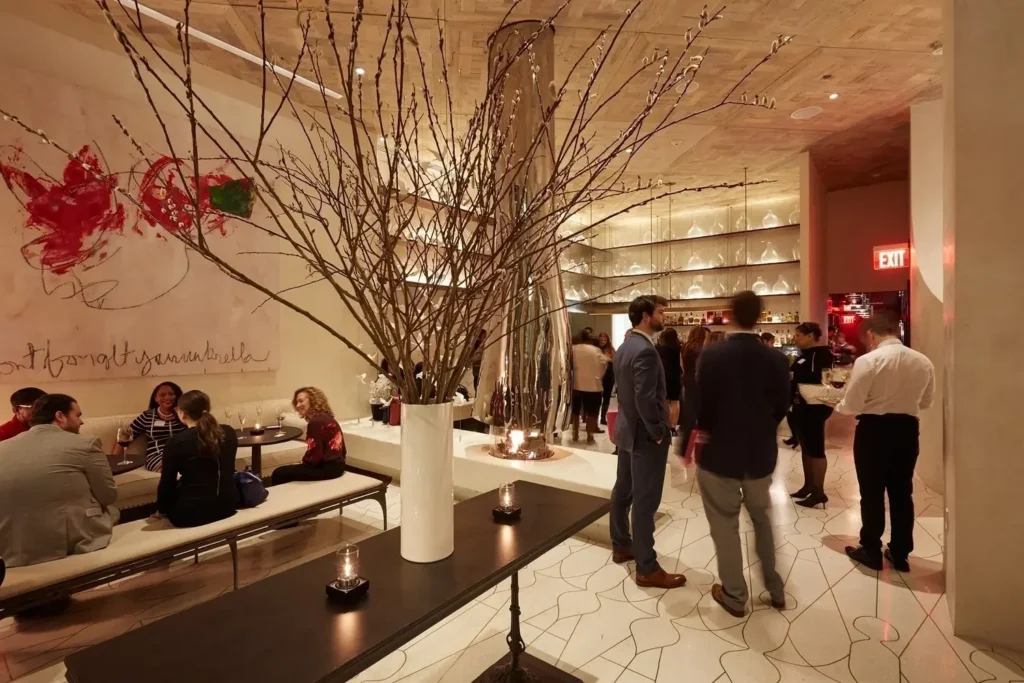
| The event | What the food must do | Format |
|---|---|---|
| Networking reception | Keep hands free and people moving | One bite items, passed or on a station |
| Team dinner | Keep everyone at the table talking | Shared boards, then a short set menu |
| Client entertaining | Signal care without ceremony | Served courses, two choices each |
| Team building | Be the activity itself | A guided tasting with pairings |
| Meeting with lunch | Not derail the afternoon | Light, no heavy carbohydrates |
Write the purpose in one sentence and hold every menu decision against it. “Thirty people who have never met, mixing for two hours” rules out anything requiring a knife and fork.
The rule is one hand. Guests are holding a drink, so anything needing two hands, a plate and cutlery will end up abandoned on a windowsill. Items should be eaten in one or two bites, be dry enough not to drip, and require no explanation.
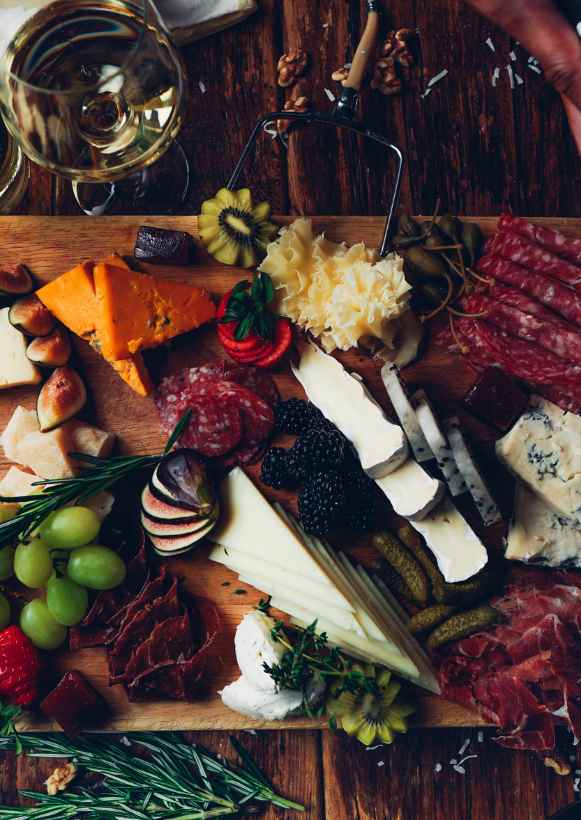
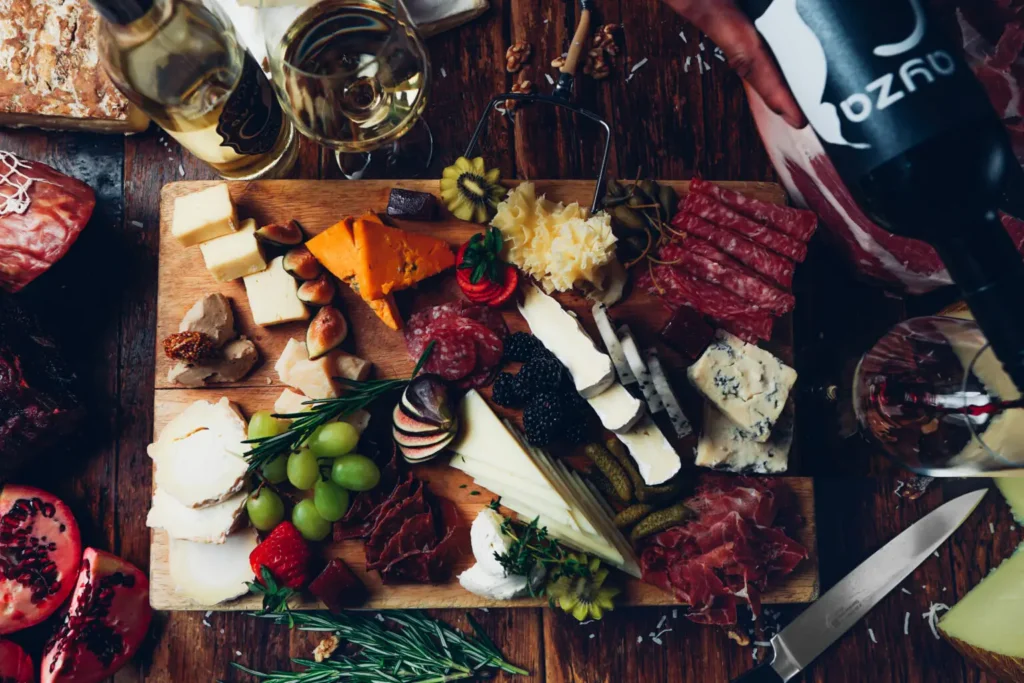
Good candidates from a menu like AYZA’s: chicken skewers with a hoisin glaze, avocado fritters with sriracha aioli, truffle waffle fries, hummus with something to dip, and white truffle pizza cut into small pieces. A cheese and charcuterie board works as a station rather than as something passed, and gives people a reason to stand somewhere together, which is half the point of a reception. Full dishes and current prices are on the dinner menu.
Two practical notes. Put stations at the edges of the room rather than the centre, so people move to them and then move away rather than clustering in the middle. And provide small plates and napkins near every station, not only at the start.
Keep the menu short. Two choices per course is enough, and it lets the kitchen serve a table together rather than in waves. Ten options for twenty five people means somebody eats twenty minutes after everybody else, and that is what people remember.
A structure that works: boards to the table to start, so the first fifteen minutes are shared rather than individual, then a main course with a meat, a vegetarian and a clearly marked vegan or gluten free option. From the AYZA menu that maps to the Fromage Board at $35 or the Maison Board at $39, then Braised Short Rib at $33, Roasted Chicken at $27, Pici Cacio e Pepe at $24 and Cauliflower with Wild Mushrooms at $25, the last of which is both vegan and gluten free.
Then dessert, which matters more at a corporate dinner than people expect, because it is when the room relaxes. Something shared works better than individual plates for the same reason boards work at the start.
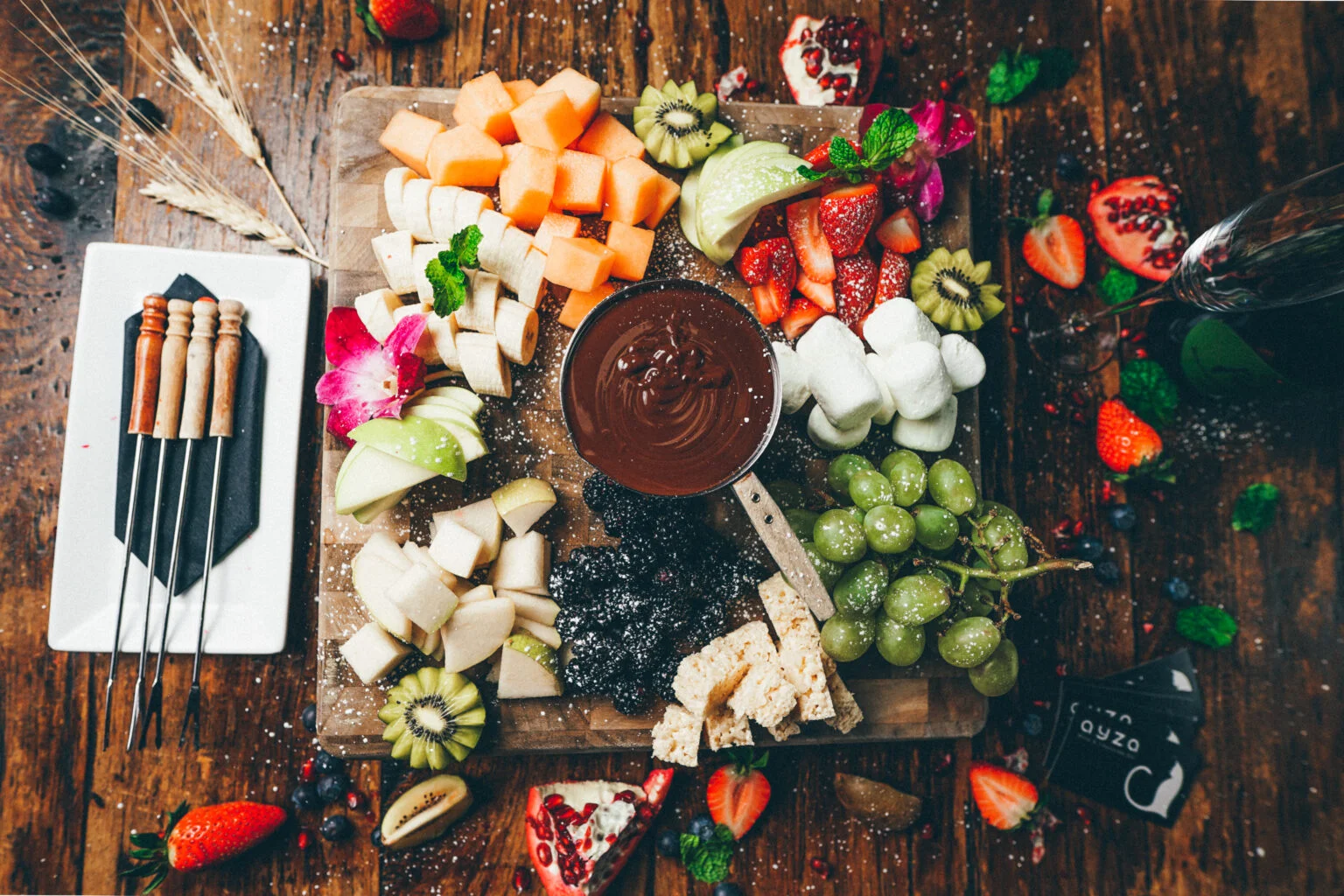
The most efficient corporate event food idea is one where the food replaces the icebreaker. A guided tasting hands everyone the same thing at the same time and asks what they think of it, which is a far lower barrier than being told to network.
| Format | Per person | Minimum | Length |
|---|---|---|---|
| Wine & Chocolate | $59 | 8 guests | 1 hour |
| Wine & Cheese | $79 | 6 guests | 1 hour |
| Wine, Chocolate & Cheese | $89 | 6 guests | 1 hour |
The chocolate format warms a room up faster, because everyone has an opinion about chocolate and nobody is embarrassed to give it. The cheese format reads as more formal and gives four wines instead of three. Semi private sessions hold up to 35 on site and off site catering has no limit. Details are on the wine tasting events page.
The failure mode is not the kitchen. It is the moment a guest has to explain their requirements out loud in front of colleagues, or is handed a plate that is visibly the afterthought version.
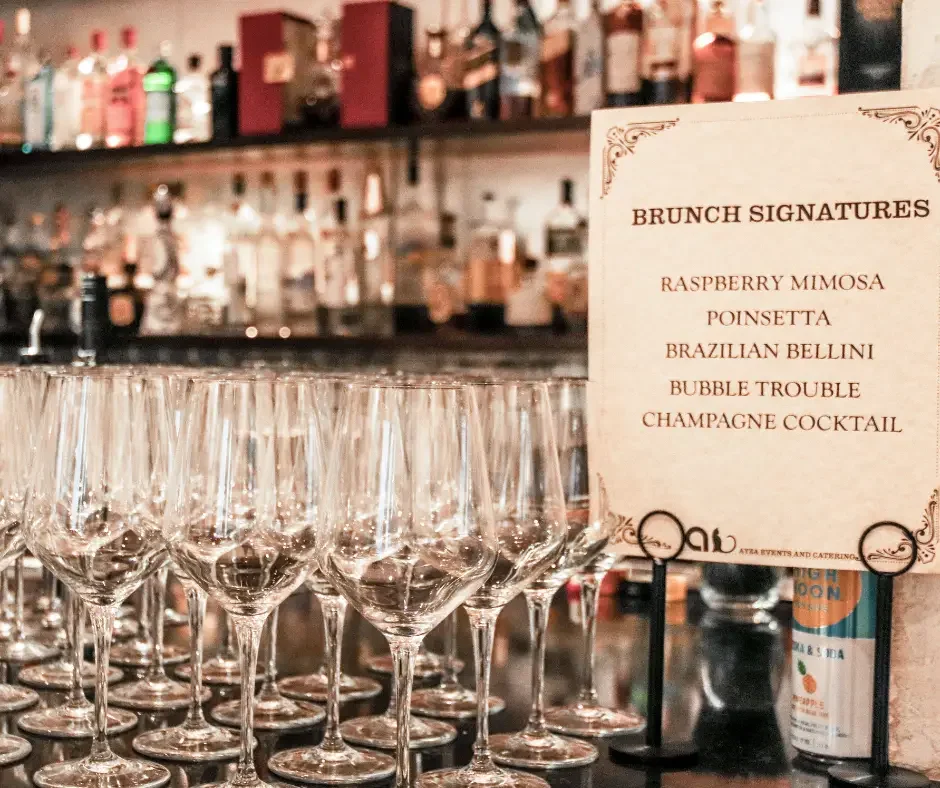
Decide the bar arrangement before the invitation goes out: open, a limited selection, or a consumption tab with a cap. A limited selection of two wines, a beer and one cocktail keeps the bill predictable, and in practice nobody complains about a shorter list at a work event.
Plan the non alcoholic options with the same care as the wine. Two properly made mocktails on a menu, included in the package rather than charged separately, does more for inclusion than any statement in the invitation. It matters for colleagues who do not drink for any reason, for anyone driving, and for a room where the most junior person should not feel obliged to hold a glass of wine.
Food arriving during a speech is the classic error, and it is entirely avoidable. Give the venue your run sheet and mark the moments where service must pause.
Three rules that hold. Never serve a course during a presentation, because people will either eat and not listen or listen and eat cold food. Put any speech after the main course and before dessert, when the room is settled but not yet drifting. And if the event has a hard finish, work backwards from it with the venue rather than forwards from the start, because the kitchen needs to know the last possible time a course can leave.
Take the per person headline and add tax and a service charge, commonly 20 percent in New York. As a working assumption, the final figure lands roughly 30 percent above the quoted price before anyone orders beyond the package. Private events at AYZA start at $69 per person, which gives you a reference to hold other quotes against.
Then itemise: food per person, drinks arrangement and its cap, tax, service, anything you bring in, overtime, and the deposit and cancellation terms. Ask specifically what happens if your guest count falls below the minimum, because RSVP lists shrink and a room priced for twenty five will still charge for twenty five. Package details are on the private events page.
Anything eaten with one hand in one or two bites, since guests are already holding a drink. Skewers, fritters, fries, dips and pizza cut small all work. Avoid anything needing a knife and fork.
Two per course. More than that slows the kitchen and means the table is not served together, which is what guests actually notice.
Collect them on the RSVP alongside drink preference, send the kitchen a list by name a week ahead, and brief the service team by seat so nobody is asked at the table.
A guided tasting. At AYZA these run one hour from $59 per person, with minimums of six or eight guests, and give everyone the same thing to react to at the same time.
Take the venue’s per person price and add roughly 30 percent for tax and service. Private events at AYZA start at $69 per person before those additions.
After the main course and before dessert, with service paused. Never during a course, because people will either eat and not listen or listen and eat cold food.
The best corporate event food ideas are the ones chosen after the agenda, not before it. Send your format, headcount range and the shape of the evening, and ask for a menu built around it rather than a list to pick from.
If food sits out through a long session, the holding times published on FoodSafety.gov are the ones caterers work to.
Menu items, prices, tasting formats and capacities were checked against ayzanyc.com on September 9, 2026.